
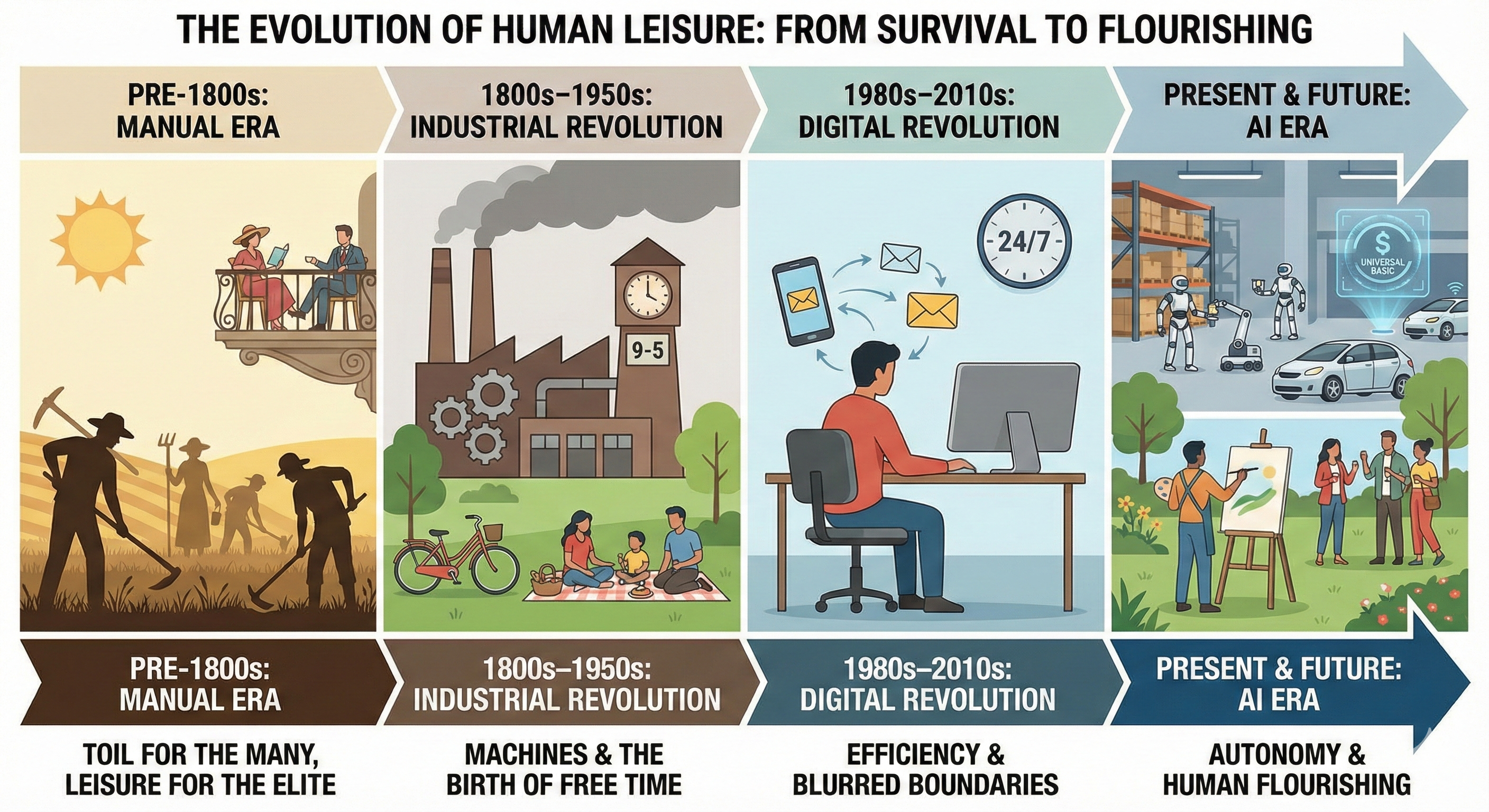
For the vast majority of human history, "leisure" was not a time of day—it was a class of people.
Two centuries ago, the concept of a "weekend" or "retirement" was virtually unknown to the common laborer. Life was dictated by the rising sun, the harvest, or the relentless demand of basic survival. Today, we stand on the precipice of a new era where Artificial Intelligence and autonomous systems promise to fulfill a prophecy centuries in the making: the liberation of humanity from the necessity of toil.
To understand where we are going, we must first look at the arduous path we have traveled.
The Era of Muscle and Sweat (Pre-1800s)
In the pre-industrial world, work was the overwhelming condition of existence. While agrarian societies did have seasonal downtimes (such as winter in Northern Europe), the daily grind was physically exhausting and precarious.
The Elite Privilege: Leisure was largely the exclusive domain of the aristocracy. The top 1–5% of society had the time to engage in art, philosophy, politics, and "high culture" because their existence was subsidized by the manual labor of the masses.
The Manual Reality: For the rest, work was synonymous with survival. There was no clear distinction between "work" and "life"—you worked to eat, and you ate to work.
The Industrial Revolution: The Gift of Time (1800s–1950s)
The First and Second Industrial Revolutions changed the calculus of human labor. For the first time, machines began to do the heavy lifting that human muscles had done for millennia.
Initially, this transition was brutal; early factory workers often toiled for 14 to 16 hours a day. However, as productivity skyrocketed, a surprising economic phenomenon occurred: we could produce more goods in less time.
The Birth of the Weekend: Labor unions and progressive industrialists (like Henry Ford, who popularized the 40-hour workweek) realized that rest improved productivity.
Democratization of Leisure: By the mid-20th century, the "common person" had gained something previously reserved for kings: free time.3 The rise of public parks, cinemas, and vacation time marked a structural shift in society.
The Digital Revolution: The Efficiency Paradox (1980s–2010s)
The introduction of computers and the internet promised to accelerate this trend. In 1930, economist John Maynard Keynes famously predicted that by 2030, his grandkids would work just 15 hours a week. He believed technology would solve the "economic problem" of scarcity.
Yet, as the Digital Revolution matured, Keynes’ prediction failed to materialize. Why?
The Blur of Boundaries: Smartphones and email tethered us to our jobs 24/7.
Parkinson’s Law: "Work expands to fill the time available for its completion." Digital tools made us faster, but we simply crammed more work into the same hours.
Cognitive Load: Instead of manual fatigue, we traded it for mental burnout. The digital age gave us entertainment, but it often left us too exhausted to truly enjoy it.
The AI Era: The Human Renaissance (Present & Future)
We are now entering the Fourth Industrial Revolution, driven by AI, robotics, and autonomous systems. This era differs fundamentally from the previous ones.
Physical AND Cognitive Automation: The Industrial Revolution outsourced our muscles; the AI Revolution is outsourcing our routine cognition. Robots are beginning to handle logistics, manufacturing, and driving, while AI handles scheduling, data analysis, and coding.
The End of "Drudgery": The jobs most likely to be automated are often the ones humans enjoy least—repetitive, dangerous, or dull tasks.
Living as Humans: The promise of this era is a shift from "Human Doing" to "Human Being."
What Does "Living as Humans" Look Like?
If machines can handle the logistics of survival, humans are freed to focus on what AI cannot do: connect, create, and care.
The Care Economy: We may see a massive boom in roles centered on empathy—teaching, coaching, nursing, and elderly care—where human presence is the premium product.
Creative Flourishing: With the cost of technical execution dropping (thanks to generative AI), more people can express themselves artistically without needing years of technical training.
Community and Philosophy: Just as the Greeks spent their leisure debating democracy, a post-work society allows time for community building, civic engagement, and philosophy.
The Challenge Ahead
The technological capability for this "Golden Age of Leisure" is nearly here, but the transition requires us to solve a new problem: distribution.
In the past, if you didn't work, you didn't eat. In an age where robots do the work, we must decouple "survival" from "employment." Concepts like Universal Basic Income (UBI) or Universal Basic Services are moving from fringe theories to serious economic discussions.
If we can solve the economic distribution, the AI era offers a profound return to our roots, but with a modern twist: we can finally enjoy the community and creativity of our ancestors, without the crushing burden of their survival.
Conclusion
Two hundred years ago, we worked to survive. Today, we work to build the machines that will survive for us. The destination of this long journey is not a world of idleness, but a world of agency—where the majority of humanity, not just the elite, has the freedom to decide what their life is actually for